



















































































































































































































































































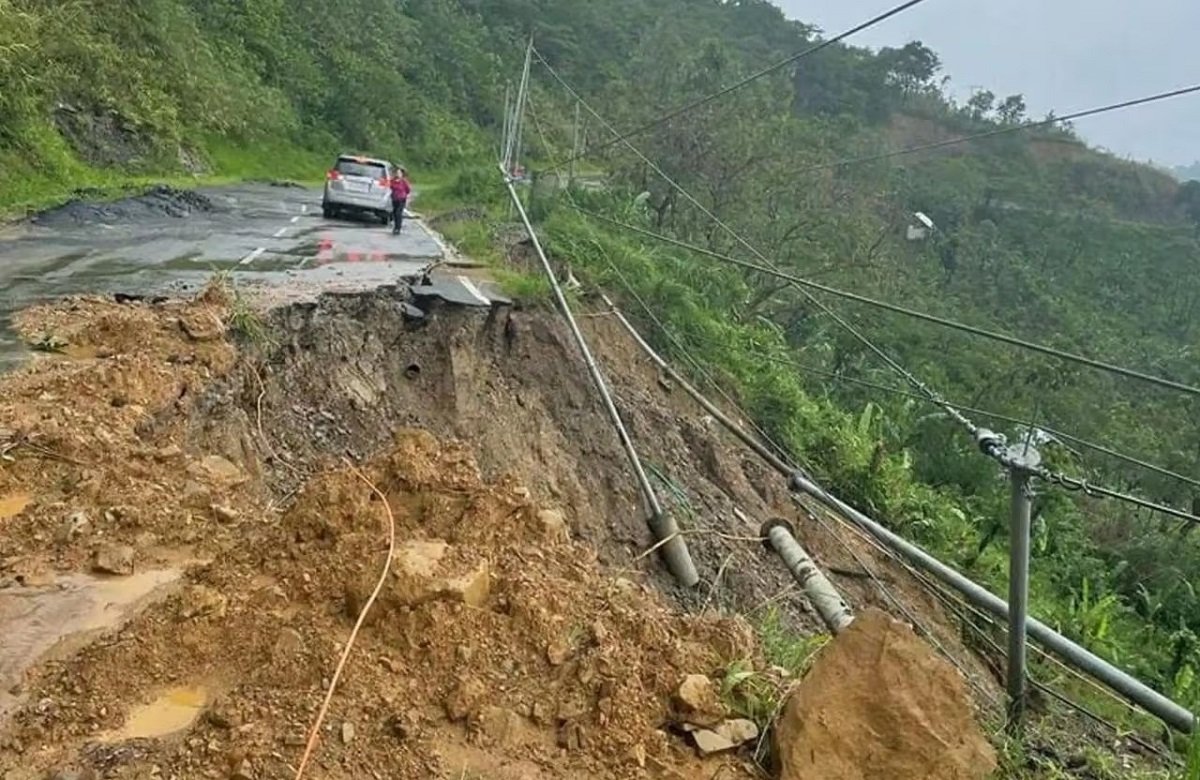
A recent review of landslide risks in Arunachal Pradesh has once again brought attention to the urgent need for building rules designed specifically for mountain regions. Experts say that existing construction standards followed across the country do not fully address the unique geological and environmental challenges faced by hill states like Arunachal Pradesh.
The issue came into focus during a technical discussion held this week, where scientists from the Centre for Earth Sciences and Himalayan Studies (CESHS) examined landslide hazards along some of the state’s most vulnerable transport corridors. These routes are critical for daily travel, supply of essential goods, and emergency services, yet they remain highly exposed to landslides, especially during the monsoon season.
The CESHS team, led by its Director Tana Tage, held detailed discussions with Dr Pinom Ering, a geotechnical engineering expert from IIT Bombay and a member of the National Building Code committee. The meeting focused on two major concerns — the limitations of current landslide early-warning systems and the lack of construction guidelines suited for steep, fragile mountain terrain.
Experts pointed out that many landslides in Arunachal Pradesh are triggered not only by heavy rainfall and seismic activity, but also by road cutting, slope modification, and construction practices that do not consider local ground conditions. As a result, buildings, roads, and other infrastructure often become unsafe within a short period of time.
During the interaction, Dr Ering shared suggestions on improving landslide monitoring by using more field-based scientific instruments. These include tools such as piezometers to measure underground water pressure, extensometers to track ground movement, and advanced techniques like Electrical Resistivity Tomography and Multichannel Analysis of Surface Waves. The use of drones equipped with Ground Penetrating Radar was also discussed as a way to study unstable slopes without putting human lives at risk.
Scientists explained that when these instruments are combined with artificial intelligence and machine-learning models, they can help develop a more reliable and physics-based early-warning system. Such a system, they said, could provide timely alerts to authorities and road users, especially along landslide-prone highways and hill roads that frequently get blocked.