












































































































































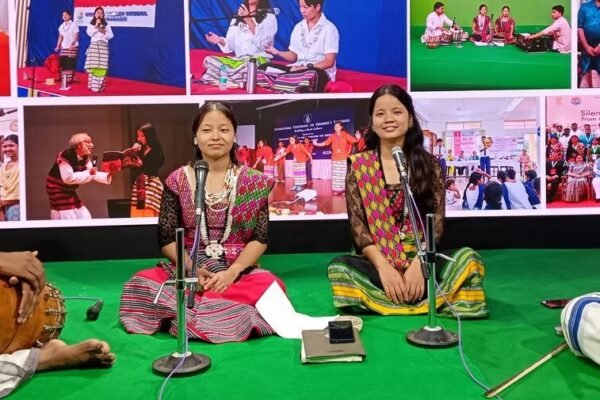
















































A two-day National Seminar on Archaeology in Arunachal Pradesh concluded at Jawaharlal Nehru College (JNC), Pasighat, on Friday with a strong call for placing indigenous voices at the centre of archaeological research and historical interpretation in the state. The seminar was organised by the Department of History, JNC, and sponsored by the Indian Council of Historical Research (ICHR). It was coordinated by Dr. Leki Sitang, Vice Principal of the college, with support from co-coordinators Dr. P.D. Mize and Dr. Nuyu Mize under the guidance of History Department Head Talut Talom.
The inaugural session began with the felicitation of dignitaries, followed by a welcome address from Dr. Sitang, who highlighted the seminar’s core theme of reclaiming the region’s historical narrative. He called upon scholars to move beyond externally constructed versions of Arunachal’s past. “We must reconstruct and reinvent our history through diligent study and authentic interpretation of archaeological data. Only then can we produce a narrative that truly speaks for the people of this land,” he said.
Keynote speaker Prof. Byomkesh Tripathy underscored the vast and largely unexplored potential of Art and Archaeology in Arunachal Pradesh. He emphasised the need for a holistic approach that integrates geography, regional histories and ancient modes of trade and migration. Drawing connections with Tibet, Myanmar and the Indian plains, he stressed that local tribal knowledge systems must remain central to any credible study of the region’s past.
Chief Guest Oken Tayeng, MLA of the 39th Mebo Assembly Constituency, highlighted the national importance of indigenous perspectives. He said archaeological research must begin with tribal narratives, oral histories and traditional wisdom, supported by scientific evidence from excavation sites. “Every piece of debris holds a clue. Arunachal’s archaeological discourse must deepen community involvement and ensure wider public engagement,” he noted.
JNC Principal Tasi Taloh expressed pride that the institution was hosting a seminar focused on preserving local wisdom. He said meaningful local participation is essential to safeguarding the region’s cultural and historical identity. On the occasion, dignitaries also released an abstract volume compiling the seminar’s presentations.
The seminar featured two in-depth technical sessions. The first was led by Prof. Marco Babit Mitri of NEHU, who stressed the need for new methodological approaches that connect archaeological findings with oral traditions and indigenous interpretations. He urged scholars to treat the landscape as a living repository of memory and to avoid simplistic or uniform explanations of the past.
The second session was conducted by Prof. Chandan Kr Sharma of Dibrugarh University, who focused on cultural connectivity across communities. He said archaeology helps establish that no society evolves in isolation, and that scientific evidence of structures, artefacts and cultural practices can illuminate longstanding exchanges and movement shaping Arunachal’s history.