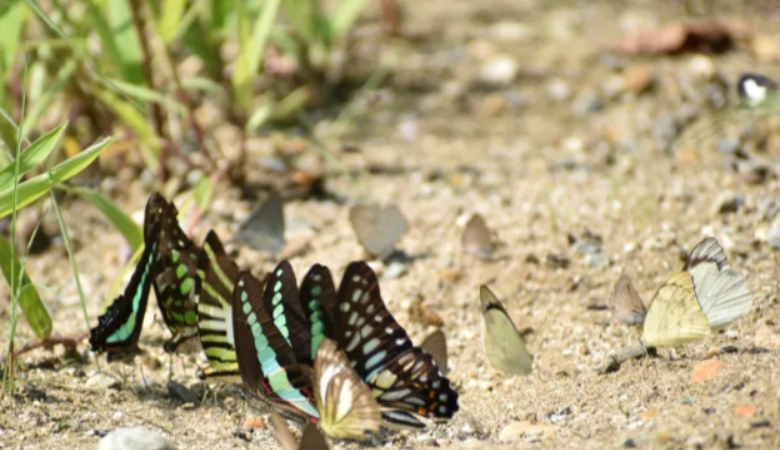
Butterflies in Arunachal Pradesh are far more selective about their “mud puddling” behaviour than previously understood, according to a new scientific study conducted in the Talle Valley Wildlife Sanctuary in Lower Subansiri district.
The research, published in the International Journal of Tropical Insect Science, found that different butterfly species and families prefer specific nutrient-rich substrates such as wet sand, stream puddles, rocks, wild animal dung, and decaying organic matter rather than gathering randomly on moist surfaces.
Mud puddling is a common behaviour seen mainly among male butterflies, where they collect minerals and nutrients like sodium and amino acids from damp surfaces essential for survival and reproduction.
The study was carried out over a two-year period by researchers Tajo Kamra and Sudhanya Ray Hajong from North-Eastern Hill University (NEHU), Shillong. The researchers documented mud puddling behaviour among 63 butterfly species across 11 different substrate types in the biodiversity-rich sanctuary.
According to the findings, wet sand, stream puddles, rocks, and wild animal dung emerged as the most preferred puddling sites, while bird droppings, wet soil, and decaying plant matter attracted fewer butterflies.
Species such as Udara dilecta, Junonia iphita, Byasa polyeuctes, and Dodona adonira recorded the highest frequency of substrate use during the study.
The research also identified distinct preferences among butterfly families. Species belonging to the Nymphalidae family were found to be the most adaptable, using a wide range of substrates. Pieridae butterflies showed a strong preference for stream puddles and wet sand, while members of the Riodinidae family were commonly observed on rocks and wild animal dung.
Researchers also observed seasonal changes in puddling patterns. During monsoon and post-monsoon periods, butterflies mainly depended on rainwater and stream puddles, whereas in winter many species shifted towards organic matter such as leaf decay and bird droppings.
The study further noted that butterflies spent longer periods puddling on wet soil, rainwater puddles, and wild animal dung, indicating that these sites may provide richer nutrient sources.
Researchers said the findings highlight the ecological importance of preserving moisture-rich microhabitats and organic resource zones within forest ecosystems.
“Understanding these substrate preferences is crucial for conservation efforts, as habitat modifications that reduce access to critical types of substrate may disproportionately affect butterfly populations,” the study stated.
The researchers also warned that habitat degradation, changing rainfall patterns, and seasonal water fluctuations could affect the availability of preferred puddling sites, potentially impacting butterfly diversity and behaviour in fragile Himalayan ecosystems.