




















































































































































































































































































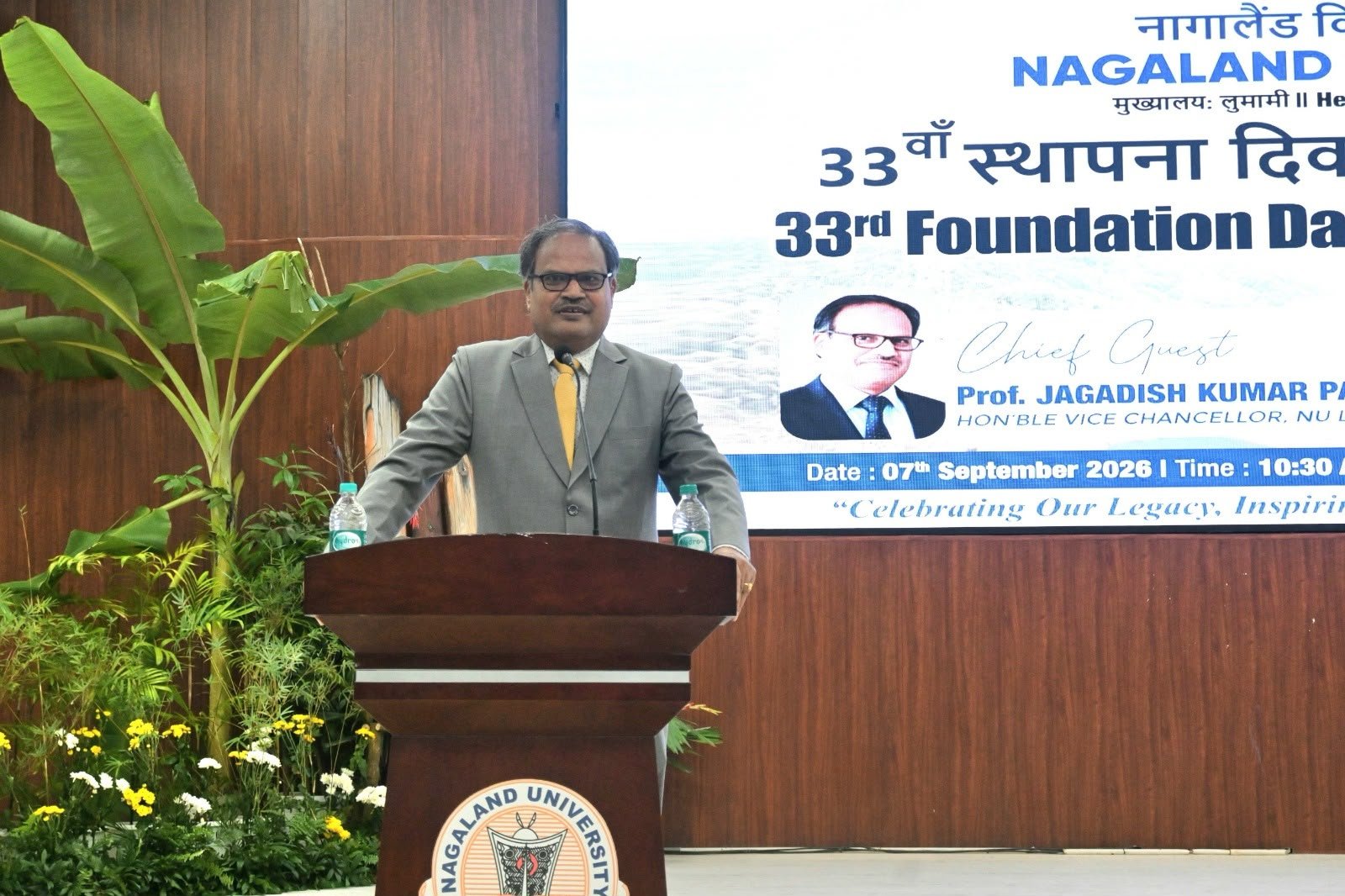
Nagaland University Celebrates 33rd Foundation Day, Honours Excellence Across the University
Lumami, Nagaland, 7 September 2026: Nagaland University, the only Central University in the State, celebrated its 33rd Foundation Day today at its Headquarters in Lumami, marking another significant milestone in its academic, research and institutional journey.
The celebrations highlighted the University’s growing contributions to research and innovation, regional development and national impact. Outstanding contributions by teachers, researchers, students and non-teaching staff were also recognised during the event.
The Foundation Day celebrations reaffirmed Nagaland University’s commitment to academic excellence, research addressing regional priorities, innovation, multidisciplinary collaboration and contributing to the educational, social and economic development of Nagaland, the North-East and the nation.
Established in 1994 by an Act of Parliament, Nagaland University currently comprises six schools, 43 departments and five Centres of Studies. It has permanent campuses at Lumami, Kohima and Medziphema, along with 70 affiliated colleges across Nagaland. The University has 242 teaching and 618 non-teaching staff.
During the academic year 2025–26, the University awarded 100 PhD degrees, 791 postgraduate degrees and 6,452 bachelor’s degrees, in addition to degrees in B.Ed., M.Ed., Nursing and LLB programmes.
The Foundation Day programme was attended by Prof. Jagadish Kumar Patnaik, Vice-Chancellor, Nagaland University, as the Chief Guest. Dr. Abemo, Registrar, Nagaland University, was the Guest of Honour, while Dr. Pitheli K. Jimo, Department of Sociology, Nagaland University, chaired the programme.
Addressing the gathering, Vice-Chancellor Prof. Jagadish Kumar Patnaik said that Nagaland University possesses the intellectual and institutional resources required to achieve greater heights.
“Nagaland University has all the intellectual and other resources needed to reach greater heights. Our responsibility is to tap these resources to their fullest extent and transform the University’s potential into reality. That transformation is already unfolding, particularly through research, innovation and the creation of start-ups.”
Prof. Patnaik further emphasised the importance of effective governance in institutional development.
“Governance is the key to development. Over the past four years, we have focused on policy-oriented governance, mobilisation of resources and incentivisation to create an ecosystem that encourages research, innovation and productive creativity. The progress in publications, patents, start-ups and other innovations shows what can be achieved when the energies of the University community are organised towards a common vision.”
The Vice-Chancellor highlighted the University’s emergence as a centre for start-ups and innovation, demonstrating the potential of a higher education institution located in one of the country’s remote regions to generate ideas and solutions of national relevance.
Over the past year, Nagaland University has strengthened research in a wide range of areas, including environment and climate, biodiversity, indigenous knowledge, healthcare, agriculture, rural livelihoods, new materials, energy storage and emerging technologies.
Research undertaken by the University has generated important insights into soil and environmental degradation, river health, land-use change, glacier retreat and the stability of high-altitude lakes across the North-East.
Researchers have also documented indigenous herbal knowledge, explored the medicinal and potential cancer-fighting properties of traditional plants, and identified biodiversity and genetic resources with potential applications in healthcare and climate resilience.
In the fields of agriculture and rural livelihoods, the University has developed the high-yielding ginger variety ‘SAS-KEVÜ’, advanced research on biochar and sustainable agriculture, and supported a backyard poultry initiative through which women’s self-help groups generated more than ₹30 lakh.
Research on biodegradable electrolytes, flexible supercapacitors, wastewater resource recovery, artificial intelligence and quantum technologies further reflects the expanding and multidisciplinary nature of the University’s research portfolio.
Nagaland University has emerged as a leading government university in the area of patent generation. In 2025, it was reported as the top government university in India for patents granted over the preceding three years, with 97 patents.
In the India Today India’s Best Universities 2026 rankings, the University was ranked No. 2 among government universities in India for patents granted and 5th for patents published, with 68 patents granted over the three-year period cited.
The University’s Intellectual Property Rights (IPR) Cell, established in October 2023, continues to support faculty members, researchers and students in patent and utility-model applications. The initiative is helping strengthen the translation of academic research into practical innovations.
The University’s Multidisciplinary Research Centre (MDRC) is also strengthening interdisciplinary collaboration in research, innovation, product development and the practical application of science and technology. The Centre brings together faculty members and students from different disciplines and supports multidisciplinary undergraduate and doctoral research.
A major highlight of the Foundation Day celebrations was the presentation of the Vice-Chancellor’s Awards 2026, instituted to recognise excellence among teachers, non-teaching employees, research scholars, postgraduate students and undergraduate students across the University.
The awardees were recognised for their outstanding dedication, commitment and exemplary service to Nagaland University.
The 33rd Foundation Day celebrations reflected the University’s continuing journey towards academic excellence, research-led innovation, institutional development and greater contributions to Nagaland, the North-East and the nation.