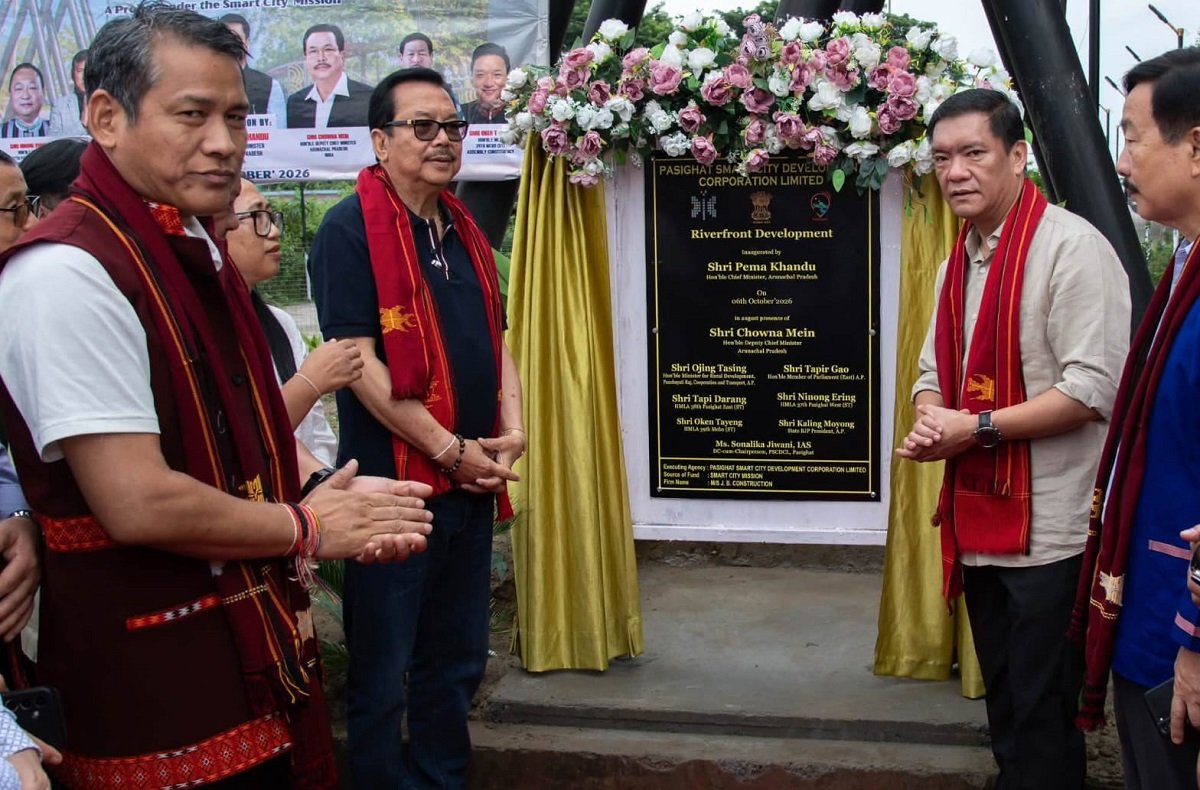
Arunachal Pradesh Chief Minister Pema Khandu on Tuesday dedicated to the people several major infrastructure projects completed under the Pasighat Smart City Mission, describing the transformation of the State’s oldest town as an important example of the development taking place across Arunachal Pradesh.
Among the projects developed by the Pasighat Smart City Development Corporation Limited, the Siang Riverfront Development, Smart Guest House and Recreation Centre are already being operated under revenue-generating models.
Twenty-two completed projects have also been handed over to the Pasighat Municipal Council and other concerned departments and agencies for operation and maintenance, while the remaining completed projects are ready for handover.
The Siang Riverfront, upgraded market area, Smart Guest House, District E-Library, Recreation Centre, Smart Roads, Solid Waste Management facilities and Integrated Command and Control Centre have added new dimensions to Pasighat’s urban infrastructure and public amenities.
The Chief Minister also inaugurated the Mebo Entry Gate infrastructure on the occasion.
Addressing the gathering, Khandu recalled that the Smart Cities Mission was launched by Prime Minister Narendra Modi in 2015 with the objective of taking cities across the country to a new level of urban development.
He said Pasighat was accorded Smart City status in June 2017 following sustained efforts by the State Government.
He noted that Arunachal Pradesh is the only State in the Northeast to have two Smart Cities, Pasighat and Itanagar, and expressed gratitude to the Prime Minister, the Union Government and the Ministry of Housing and Urban Affairs for supporting the State’s proposal.
Of the 43 projects taken up under the Pasighat Smart City Mission, 42 have been completed, he said, adding that the remaining Sewage Treatment Plant is also expected to be completed soon.
The Chief Minister said the infrastructure being created through the Smart City Mission must now translate into better opportunities and a better quality of life for citizens.
He particularly urged citizens to take ownership of public infrastructure and ensure its proper maintenance.
“Government infrastructure is created for the public. It is public property, and maintaining it is also the responsibility of the public,” Khandu said, calling for greater community participation alongside the administration and elected representatives.
He cited the upkeep of public infrastructure in Tawang as an example of strong public ownership and expressed confidence that the people of the Adi community would demonstrate a similar sense of responsibility towards the newly created assets.
Linking Pasighat’s transformation with the larger development vision for the State and the country, the Chief Minister said Arunachal Pradesh must contribute meaningfully to the goal of a Viksit Bharat by 2047.
“Viksit Bharat will happen only when Arunachal Pradesh is developed. Without Arunachal Pradesh, India cannot become Viksit Bharat,” he said, urging elected representatives, administrators and citizens to contribute towards building a Viksit Arunachal by 2047.
He said the State has already initiated its planning process for the vision and would further firm it up in consultation with stakeholders.
The Chief Minister stressed that the next phase of development must focus particularly on the aspirations of the youth. Government policies and platforms, he said, should create avenues for educated youth as well as those in rural areas to find sustainable livelihoods.
He called for innovative approaches at the level of MLAs, councilors and panchayat representatives so that local opportunities could be converted into viable economic activities.
Pointing to Siang’s tourism potential, Khandu said the newly created riverfront and improved road and communication infrastructure could be leveraged to attract tourists and generate local employment.
He suggested that even innovative concepts such as mobile restaurants could be explored to create new attractions and livelihood opportunities.
The Chief Minister called upon officers to make greater use of convergence among Central and State schemes to maximize the impact of public expenditure.
He said the Smart City Mission itself provided an example of such convergence.
Of the total cost of the projects, around Rs 490 crore was allotted by the Government of India, while Rs 51.77 crore was provided by the State Government and Rs 3.94 crore mobilised through convergence funding.
“Convergence should not be one plus one equals two; it should be one plus one equals eleven,” Khandu said, urging officials to study various schemes and strategically combine them to create more infrastructure and employment opportunities.
He also highlighted agriculture, horticulture and other sectors as avenues for engaging youth, stressing that Arunachal’s fertile land and diverse resources offer significant scope for entrepreneurship.