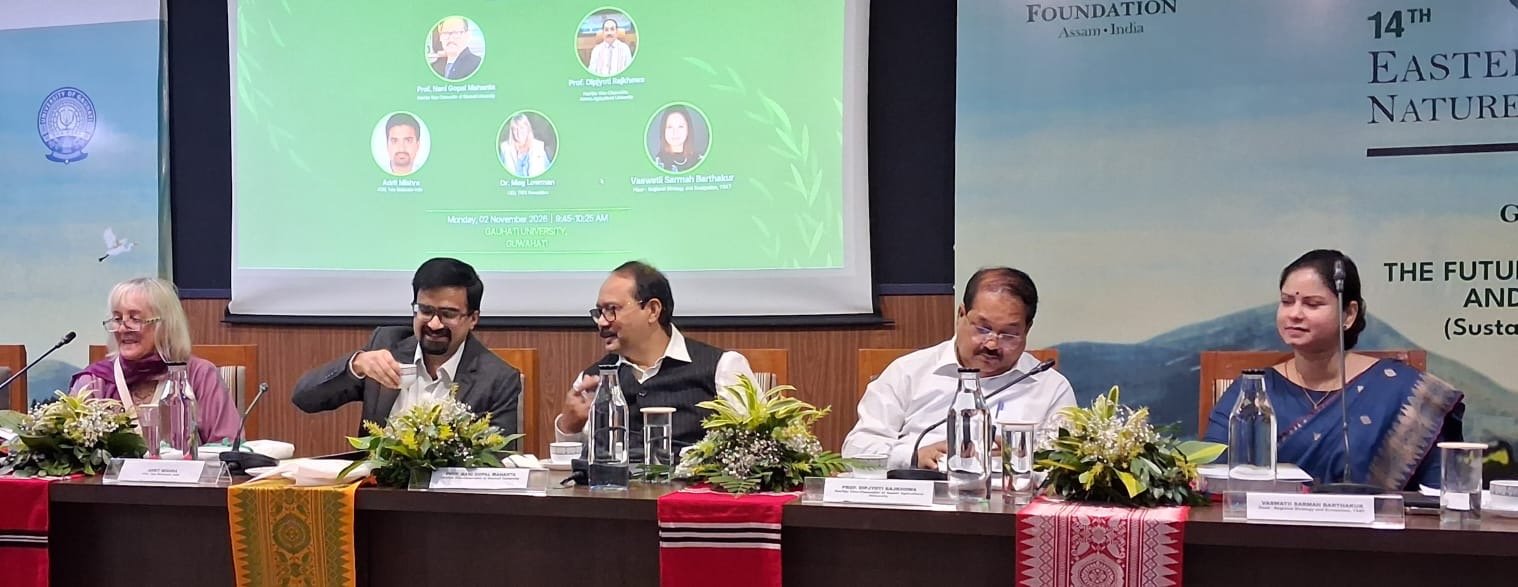
The 14th Eastern Himalayan Naturenomics™️ Forum, organised by Balipara Foundation in collaboration with Gauhati University, brought together policymakers, academicians, industry leaders, researchers and conservation practitioners to deliberate on “Sustainable Land Futures”.
The discussions focused on regenerative land management, biodiversity conservation, sustainable livelihoods, wetland protection, circular economy and climate-resilient urban development. Emphasising the importance of community participation in shaping sustainable landscapes, Nilesh Prakash Rajadhyaksha, Country Programme Manager, UN-Habitat India, said, “Engagement with communities needs a different policy approach. You need to have more patience and account for longer timelines of change. There is a need for cross-sectoral data convergence and integration.”
The Forum featured addresses by Prof. Nani Gopal Mahanta, Vice-Chancellor of Gauhati University, and Prof. Dipjyoti Rajkhowa, Vice-Chancellor of Assam Agricultural University. International conservation experts, including Dr. Meg Lowman, CEO of TREE Foundation; Heidi Riddle, Chair of the IUCN/SSC Asian Elephant Specialist Group; and Dr. Khyne U Mar, conservationist from Myanmar, shared perspectives on ecological resilience and human–elephant coexistence. Highlighting the importance of grassroots action, Dr. Meg Lowman remarked, “Global conservation starts with local communities.”
Experts and representatives from UN-Habitat, ATREE, Wetlands International South Asia, the MS Swaminathan Research Foundation and Tata Consumer Products participated in thematic discussions and policy roundtables exploring regenerative agriculture, wetland conservation, sustainable land governance and the role of artificial intelligence and geospatial technologies in strengthening human–wildlife coexistence.
The programme also featured the launch of Wild Plants of Assam, student research presentations and a Green Innovations Gallery showcasing Indigenous knowledge, community-led conservation and sustainable enterprises.
The Forum reaffirmed the importance of collective action, stronger partnerships and community-led solutions in securing a resilient and sustainable future for the Eastern Himalaya.